AEO and GEO: A practical guide for modern brands and leaders.
Brands need to think beyond traditional SEO and understand two related disciplines: Answer Engine Optimization (AEO) and Generative Engine Optimization (GEO).

Executive summary
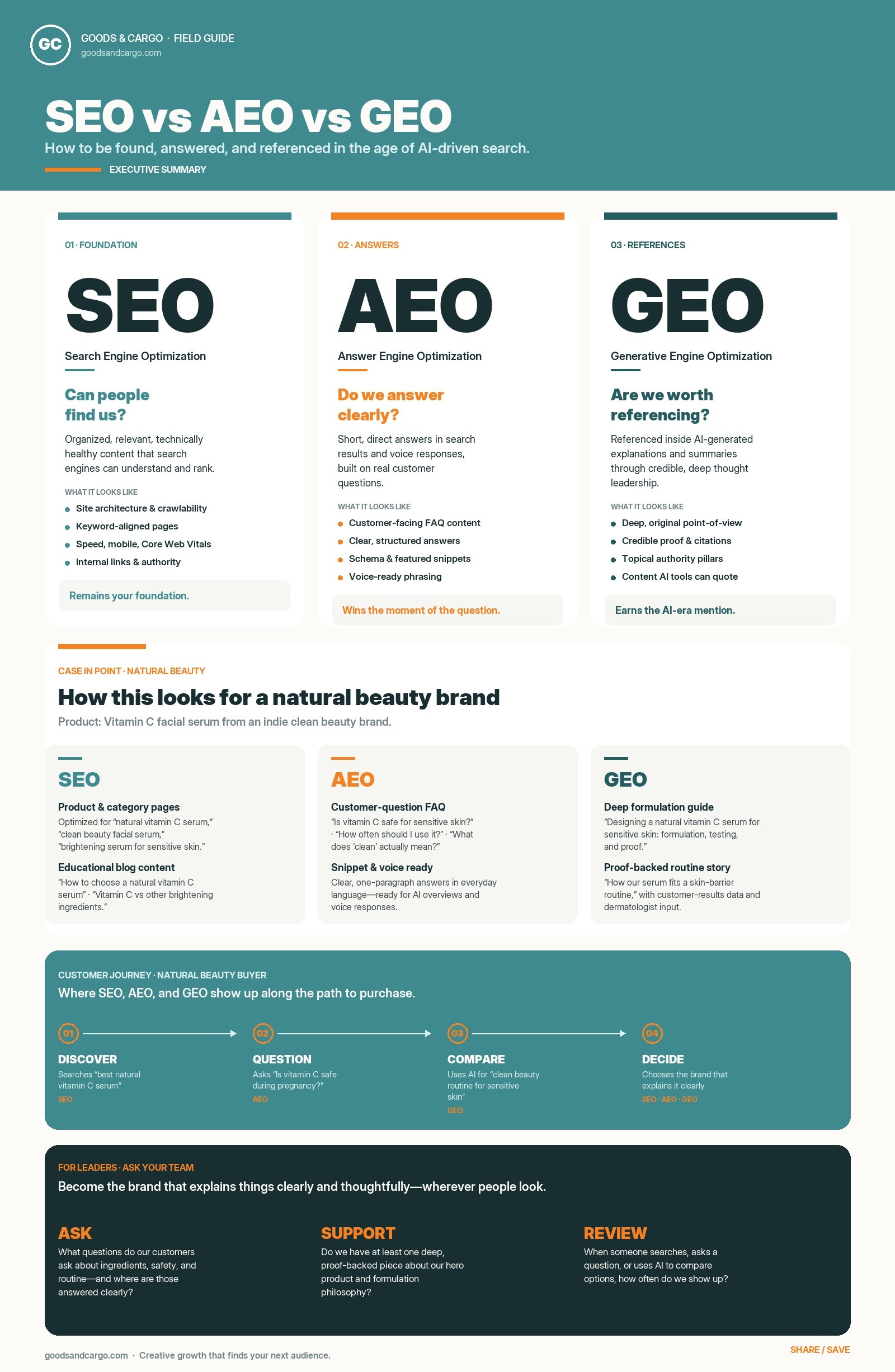
Modern search has three layers that matter for brand leaders: SEO, AEO, and GEO. SEO remains your foundation. It ensures your site is organized, relevant, and technically healthy so people and search engines can find you.
Answer Engine Optimization (AEO) focuses on clear, direct responses to the real questions your customers ask. When your content leads with concise, structured answers, your brand is more likely to power featured snippets, FAQ results, and voice responses.
Generative Engine Optimization (GEO) is about how your deeper content shows up inside AI-generated explanations and summaries. Credible thought leadership, proof-backed case stories, and well-structured guides make your brand worth referencing when AI tools assemble answers.
Together, SEO, AEO, and GEO help you:
Be found when people search.
Be trusted when they look for quick answers.
Be referenced when they rely on AI to understand the bigger picture.
Talking points for leaders & executives
You don’t need to run the tactics. You do need to ask for:
Clear customer-facing answers, a small set of strong
Deep articles on key topics
Regular reviews of how your brand appears across search and AI-driven experiences.
Ready to dive deeper?
What is Answer Engine Optimization (AEO)?
Answer Engine Optimization focuses on how well your brand shows up when people look for direct, concise answers to specific questions. Instead of only ranking full pages, AEO is about becoming the source of those short, high-value responses that appear at the top of search results or are read out by voice assistants.
You see AEO at work when:
Someone types a question and sees a small answer box at the top of the results.
“People also ask” questions appear with quick, one-paragraph responses.
A voice assistant gives a short spoken answer instead of listing websites.
In each case, a system has found a clear, well-structured answer from a source. AEO is about making your content that source.
What strong AEO looks like
AEO relies on three simple elements:
Real questions
Start with what people actually ask: “What is X,” “How does X work,” “What is the difference between X and Y,” “Is X right for me.” These questions come from sales calls, support tickets, event chat, and everyday conversations.Clear answers
Lead with the answer, then add context. Use plain language. Avoid long build-ups or “marketing speak” before you say anything useful. The first two or three sentences should make sense on their own.Structured content
Use headings, FAQs, lists, and short sections. That structure helps both humans and systems quickly find and extract the information they need.
When your content consistently offers direct, high-quality answers, you increase your chances of being surfaced in answer-oriented placements, even when the user doesn’t click through to a full page.
What is Generative Engine Optimization (GEO)?
Generative Engine Optimization is about how your brand shows up inside AI-generated answers and summaries. As more people use AI tools to research, compare options, and learn about complex topics, GEO helps your content become part of what those tools reference and assemble.
You see GEO at work when:
Someone asks a broader question in an AI assistant and gets a synthesized explanation that pulls together points from multiple sources.
An AI tool suggests brands, products, or frameworks while summarizing an industry or trend.
A user relies on generated answers to understand pros and cons before making a decision.
GEO focuses on whether your content is deep, credible, and structured enough that AI systems “see” it as useful when they build those answers.
What strong GEO looks like
GEO is built on:
Thought leadership with substance
Create articles, guides, and explainers that go beyond surface-level advice. Show how you think about the category, your audience, and the underlying dynamics. Share frameworks or lenses that make it easier to navigate complexity.Proof and examples
Include case-style narratives, data points, and specific examples. They don’t need to expose confidential details, but they should demonstrate that you’re working with real situations, not just theory.Consistent presence
Maintain up-to-date content on your own channels and, when helpful, on platforms and publications your audience trusts. Consistency matters more than volume; it signals that your thinking is current.
The goal is to become a brand that AI systems treat as a credible source when they assemble answers, not just a logo in a directory.
How AEO and GEO connect with SEO
AEO and GEO don’t replace SEO. They build on it.
SEO helps search engines understand your site: structure, topics, technical health, relevance.
AEO turns your expertise into clear, extractable answers tied to real questions.
GEO turns your deeper content into material that’s worth referencing in synthesized explanations.
Seen together:
SEO asks: “Can people and search engines find us?”
AEO asks: “Do we answer their questions clearly when they do?”
GEO asks: “Do we offer enough depth and proof that we’re worth including in the bigger picture?”
When your brand is consistent across all three, you’re more likely to appear in classic search results, answer boxes, and AI-generated summaries.
Practical steps for AEO
You can start supporting AEO without a heavy technical lift:
Collect questions
Talk with sales, support, and customer-facing teams. Look at email subject lines, chat logs, event Q&A, and social comments. Capture the recurring questions.Prioritize the top questions
Focus on questions that show up often and matter most at key decision points: before purchase, before renewal, before referral.Create or refine FAQ and answer content
Build dedicated FAQ pages or sections. Each answer should start with a clear statement, followed by concise explanation, with headings that mirror the questions.Keep language straightforward
Write as if you’re speaking to a smart, busy person who wants clarity quickly. Make it easy for them to skim and still walk away with an answer.Review and update regularly
As products, policies, or market conditions change, keep your answers current. Outdated information erodes trust fast.
Practical steps for GEO
To support GEO:
Map your “big topics”
Identify the themes where you want to be recognized as a voice: specific industry shifts, methods, customer behaviour, regulatory or operational complexity, etc.Develop deeper content around those topics
Publish articles or guides that dig into these areas with perspective, examples, and practical takeaways. Think “explainer plus insight,” not just announcements.Show your thinking
Walk through how you approach problems, what you consider, and why you choose certain paths. This kind of transparent thinking often becomes the most useful content for readers—and AI systems.Keep pieces connected
Link related pieces together so they form a coherent body of work. Make it easy for someone (or a system) to move from a high-level overview into more specific, detailed content.Refresh and expand over time
As you learn from projects, update your thought leadership. Add sections, new examples, or follow-up articles that keep your content alive and relevant.
Questions leaders can ask to guide AEO and GEO
Executives don’t need to manage tactics. They need to set direction and create space for good work. Useful questions include:
“What are the most important questions people ask before they work with us, and where can they see our answers without needing a login?”
“Which topics do we want to be known for when someone asks an AI tool about our space, and how are we showing our thinking there?”
“Where are we visible today—in standard search results, answer boxes, and AI-powered experiences—and where do we want to improve?”
“How are we measuring the impact of answer-oriented content and thought leadership beyond page views?”
These questions help teams focus on meaningful content that supports real decisions, not just quick wins.
Conclusion
Answer Engine Optimization and Generative Engine Optimization are different ways of describing something brands have always needed to do: answer real questions and share real expertise. When you design content that is easy to understand, structured around what people genuinely want to know, and rich enough to be worth referencing, you naturally become more visible in both search results and AI-generated answers.
The opportunity is to support this work with clear priorities, enough room for teams to build quality content, and a commitment to clarity over noise.
View our visual summary and field guide